World class education
In A Local Environment
Our Faculties
College of Applied Sciences
The Medical Sciences Department of Sulaiman Al-Rajhi University pursues SRU vision aiming to provide global education in a local environment to deliver high-quality education to leading applied medical science graduates who have the ability to provide diverse highly responsible and...
Read More
School of Business
The College of Business at Sulaiman Alrajhi University adopts the principles of entrepreneurship and innovation, delivering high‑quality education grounded in case‑based and experiential learning to ensure strong integration between theory and practice.
Read More
College of Medicine
The Faculty adopts a 6-year advanced educational program that delivers qualified graduates who are capable of understanding and meeting the needs of the community and providing a health service with a high level of professionalism and medical knowledge supported by...
Read More
College of nursing
The College of Nursing aims to prepare qualified nurses with high knowledge, skills, and professional practices, according to the best nursing profession standards.
Read MoreLatest News
View AllOur Announcements
View All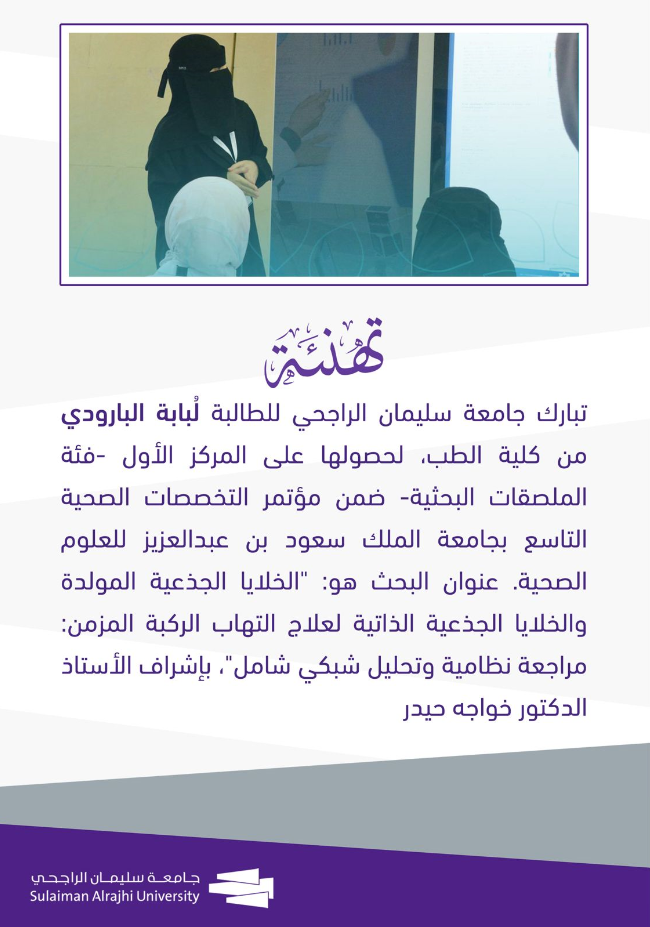
Celebrating Excellence: Lubaba Al-Baroudi Wins First Place at 9th Health Professions Conference
Congratulations Sulaiman Alrajhi University congratulates Lubaba Al-Baroudi, a medical student, for achieving first place in the research poster competition at the 9th Health Professions Conference, held at King Saud bin Abdulaziz University for Health Sciences. She presented a research study titled: “Allogeneic and Autologous Stem Cells for the Treatment of Chronic Knee Inflammation: A Systematic Review and Network Meta-Analysis.” This research was conducted in collaboration with students Maryam Bourgleh, Batoul Aybour, Aseel Al-Mesned, Rawan Al-Balawi, Shahd Al-Fawaz, and Moaz Bourgleh, under the supervision of Professor Khawaja Haider. Proud of this achievement
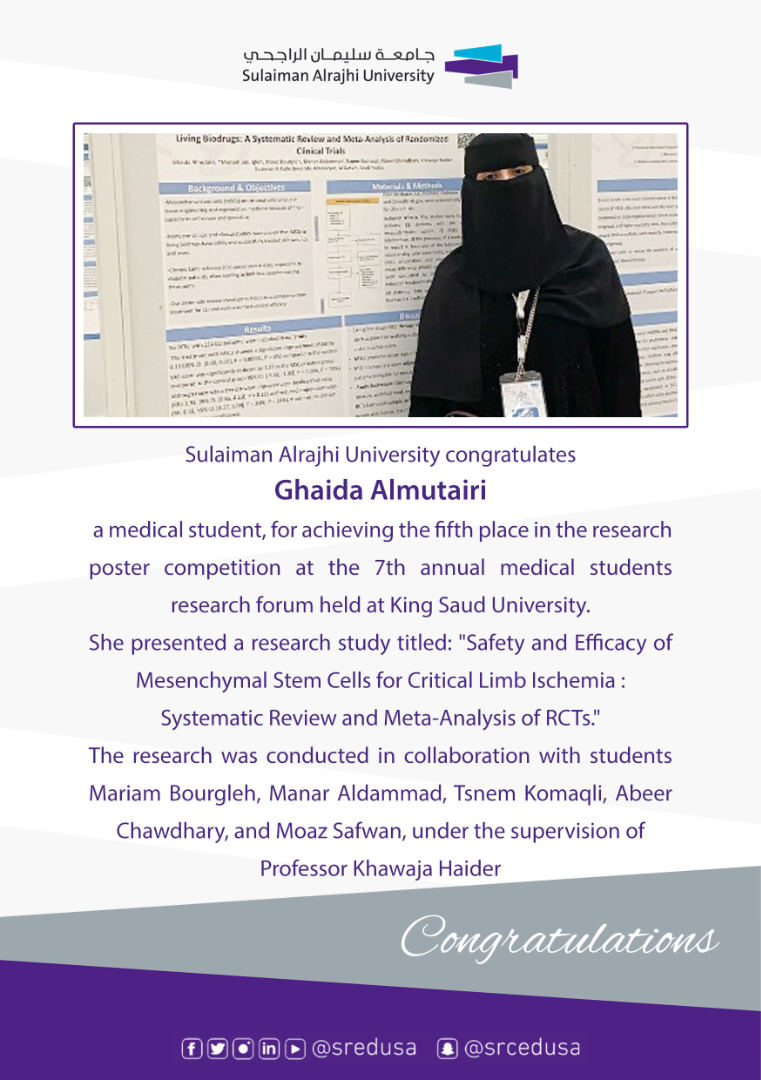
Celebrating Excellence: Ghaida Almutairi Achieves 5th Place at the 7th Annual Medical Student Research Forum.
Sulaiman Alrajhi University congratulates Ghaida Almutairi, a medical student, for achieving the fifth place in the research poster competition at the 7th annual medical students research forum held at King Saud University. She presented a research study titled: “Safety and Efficacy of Mesenchymal Stem Cells for Critical Limb Ischemia: Systematic Review and Meta-Analysis of RCTs.” The research was conducted in collaboration with students Mariam Bourgleh, Manar Aldammad, Tsnem Komaqli, Abeer Chawdhary, and Moaz Safwan, under the supervision of Professor Khawaja Haider. Proud of you for this achievement..
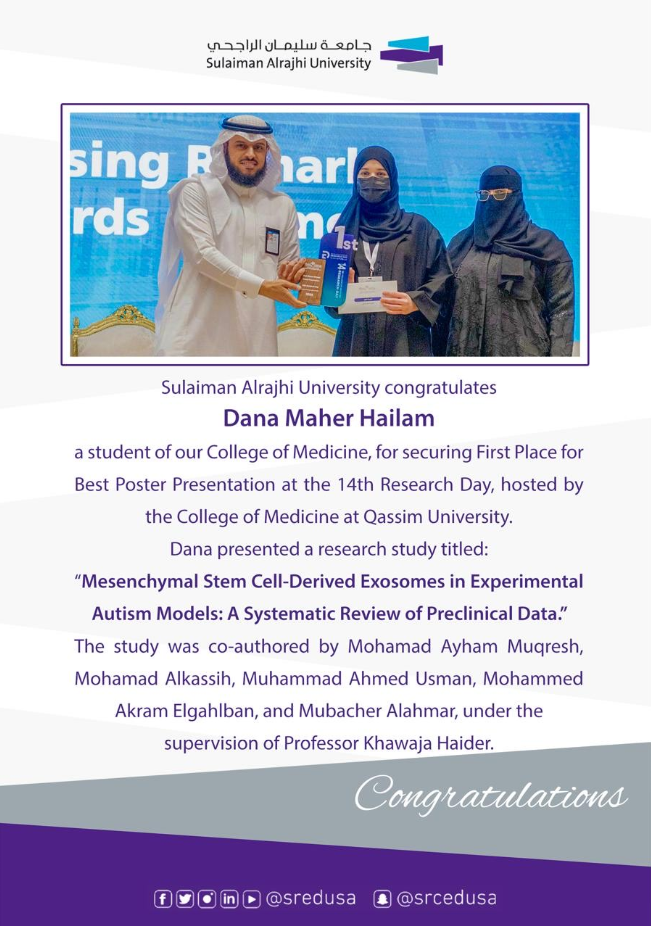
Celebrating Excellence: Dana Maher Hailam Achieves 1st Place at the 14th Research Day
Sulaiman Alrajhi University extends its heartfelt congratulations to Dana Maher Hailam, a student of our College of Medicine, for securing First Place for Best Poster Presentation at the 14th Research Day, hosted by the College of Medicine at Qassim University. Dana presented a research study titled: “Mesenchymal Stem Cell-Derived Exosomes in Experimental Autism Models: A Systematic Review of Preclinical Data.” The study was co-authored by Mohamad Ayham Muqresh, Mohamad Alkassih, Muhammad Ahmed Usman, Mohammed Akram Elgahlban, and Mubacher Alahmar, under the supervision of Professor Khawaja Haider. This achievement reflects the high standards of research excellence at Sulaiman Alrajhi University. Well done Dana and the entire team!
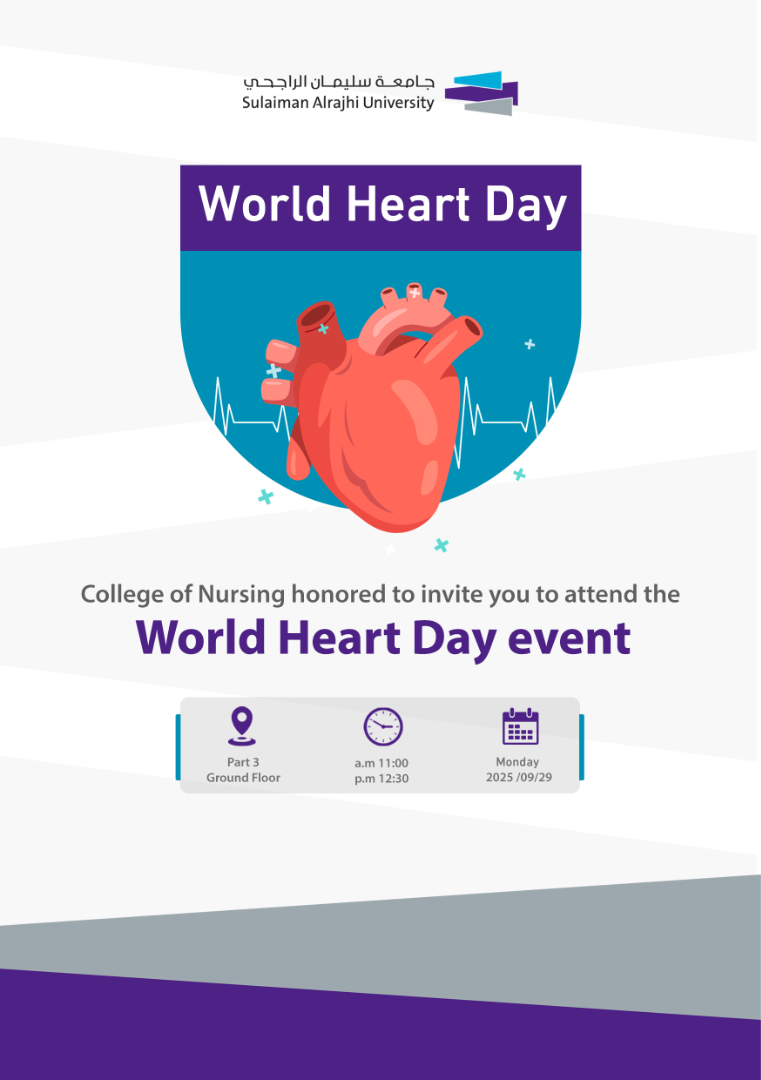
Invitation to World Heart Day Event
The College of Nursing cordially invites you to join us for a special World Heart Day event. Location: Part 3, Ground Floor Date: Monday, September 29, 2025 Time: 11:00 AM to 12:30 PM We look forward to your participation in this meaningful event to raise awareness about heart health.
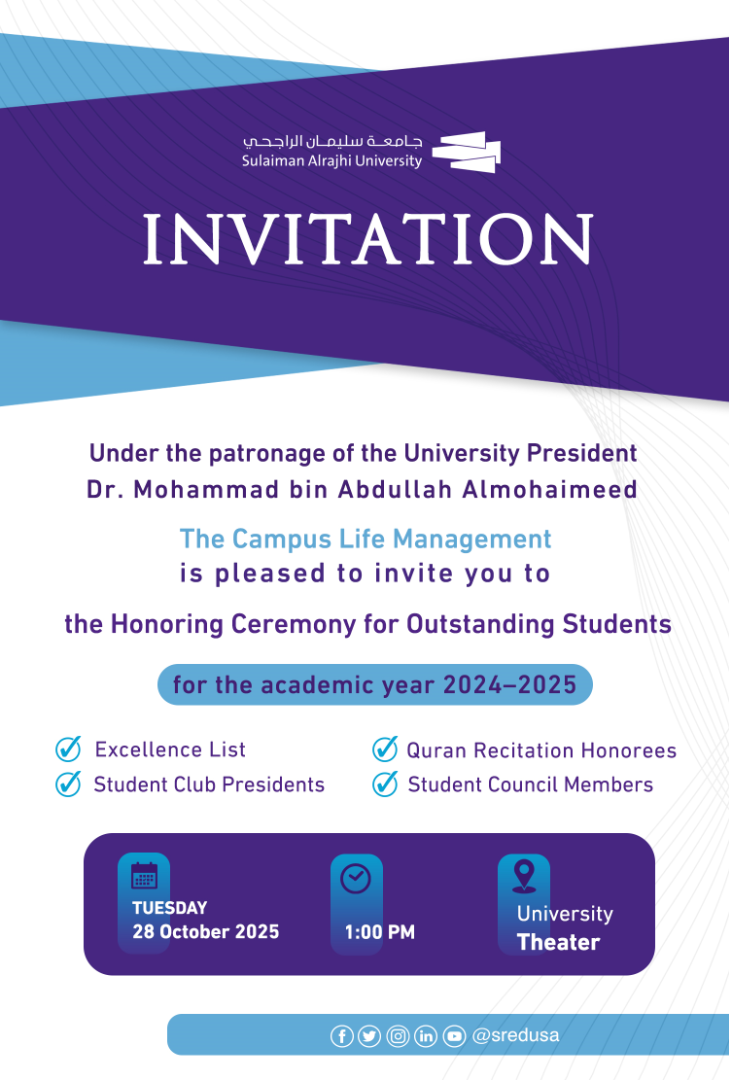
Invitation : Attend The Honoring Ceremony for Outstanding Students
Invitation to the Honoring Ceremony for Outstanding Students Under the esteemed patronage of the University President, Dr. Mohammad bin Abdullah Almohaimeed, we are delighted to announce the Honoring Ceremony for Outstanding Students for the academic year 2024–2025. This special event will recognize the achievements of our remarkable students in various categories, including: Excellence List Student Club Presidents Quran Recitation Honorees Student Council Members Event Details Date: Tuesday, 6 Jumada Al-Awwal 1447 AH Corresponding to October 28, 2025 Time: 1:00 PM Location: University Theater We cordially invite all faculty, staff, and students to join us in celebrating the accomplishments of our outstanding students. Your presence will add to the joy of the occasion and inspire our awardees to continue striving for excellence. We look forward to seeing you there